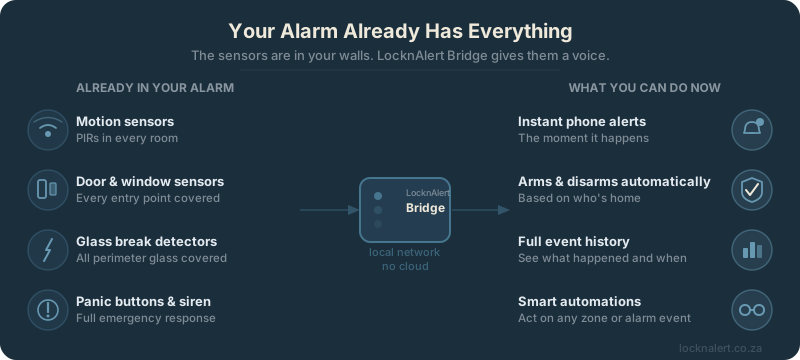
Most South African homes with a Paradox alarm have between 8 and 32 sensors already wired in and active. PIR motion detectors in every room. Door and window contacts on every entry point. Sometimes glass-break detectors, smoke sensors, panic buttons.
That is not a "dumb" alarm system. That is a comprehensive sensor network, one that took an alarm technician a full day to install, that runs on your home's own wiring, and that quietly does its job every single day.
The problem is not the hardware. The problem is that nobody told you it could do more than sound a siren.
Locked Inside a Box
Your Paradox panel (whether it is a Magellan, Spectra, or EVO) knows a remarkable amount about your home at any given moment. It knows which zone triggered. It knows whether the alarm is armed or disarmed. It knows if a specific door is open or closed. It knows about tampers, zone troubles, and bypasses.
All of that information sits inside the panel, talking to nobody.
The traditional path was to buy an IP150 module, connect to Paradox's cloud, and receive push notifications through their app. But that ties you to Paradox's servers staying online and their app not being discontinued. And in most setups, you pay a monthly fee just to access data your own hardware is generating.
There had to be a better way.
What Home Assistant Changes
Home Assistant is free, open-source home automation software that runs on a small device inside your home, usually a Raspberry Pi or a dedicated mini-PC. It does not phone home. It does not require subscriptions. It does not break when someone else's cloud server goes down.
It can talk to almost anything: lights, plugs, locks, cameras, thermostats. Hundreds of integrations, all running locally on your own network. If your internet connection goes down, your automations keep running.
The only piece missing was a reliable, local bridge between your Paradox panel and Home Assistant.
That Is What LocknAlert Bridge Does
LocknAlert Bridge connects directly to your Paradox panel's built-in serial port, the same port your alarm technician has used for years to program the panel. No IP modules. No cloud accounts. No third-party services.
The Bridge translates your panel's data into messages on your local network. Home Assistant picks those up instantly. Every zone, every arm and disarm event, every state change is available in real time, completely locally, with no internet dependency.
Once that connection exists, your existing sensor network becomes something entirely different.
Real Examples of What You Can Do
Here is what LocknAlert customers are running right now:
- Lights that follow you. When the motion sensor in the lounge triggers after dark, the lounge lights turn on automatically. Two minutes after the zone clears, they switch off. No wall switches. No schedules. No subscription.
- Presence detection that actually works. When the front door contact opens and the alarm is disarmed, Home Assistant marks you as home. When the garage zone triggers and the alarm arms in Away mode, you are away. It is not geofencing. It uses sensors already wired into your walls.
- Instant notifications you control. When a specific zone triggers (the gate, the back door, the driveway) you get a push notification with exactly which sensor fired, immediately, through the Home Assistant mobile app on your phone. No third-party alarm app, no one else's servers.
- Context-aware security responses. Alarm armed in Stay mode? Dim the exterior lights so you are not illuminating the garden for an intruder. Alarm triggered? Flash the indoor lights and make an announcement through your speakers. These automations were not possible when the panel was a closed box.
- Outdoor lighting on zone activity. Motion on the perimeter at 2am? Flood the garden with light and send a notification, without triggering the siren, without waking the household, without false alarms.
The Subscription Fatigue Is Real
There is a growing frustration among South African homeowners with subscription-based alarm services. You paid for the hardware. You paid for installation. And now you are paying monthly, indefinitely, just to use the basic features of something you already own.
LocknAlert does not work that way. You buy the Bridge once. You plug it in. It works locally, forever, without any ongoing fee.
That is not just a business model decision. It is a values decision. The hardware is yours. The data it generates is yours. The sensor network wired into your walls is yours. You should not need to rent access to it.
Is It Right for Your Home?
LocknAlert Bridge works with Magellan (MG), Spectra (SP), and EVO panels running firmware below version 7.50.000. It connects through the panel's built-in TTL serial port using the included cable. No IP150 module, no USB adapter, no third-party hardware needed.
You will also need Home Assistant running on a device on your local network. If you do not have Home Assistant yet, LocknAlert's Home Hub comes pre-configured and ready to go. You just plug it in and connect it to your panel.
Check the compatibility page to confirm your panel is supported, or send a message if you are not sure. We respond quickly.
The Sensor Network Was Always There
You did not need to spend money on a mesh of smart motion sensors. You did not need to run new cable or drill new holes. You did not need to sign up for another subscription service.
The sensor network was already wired into your walls, covering every room, every door, every entry point. LocknAlert Bridge just finally gives it a voice.
Ready to Unlock Your Alarm?
LocknAlert Bridge connects your Paradox panel to Home Assistant in minutes. No cloud, no subscription, no monthly fees.